Sunday, April 15, 2012

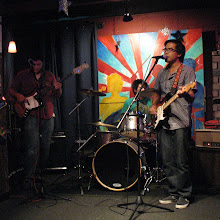
WINNER! Golden West College Battle of the Bands!

It finally happened! We had competed at the local community college battle of the bands on three separate years: 2009, 2010, and again this year. We had always placed second by a one or two point margin, so this year we were prepared. We chose our 5 favorite original songs and put them under a microscope, refining them the best we could for almost a month. It paid off. 


And there you have it! The Short Term Melody, winner of the Golden West College Battle of the Bands. It's not a Grammy, but it sure feels good anyway! 


Posted below are videos of the entire set in order of appearance. Enjoy!


"California Sun"

"Circles"

"M.I.A."

The closer: "So Much / I Can't Be Anybody Else"

Saturday, December 24, 2011

Vids from the Prospector show!

So earlier this week, we played a great show at the Prospector, a local Long Beach bar/venue/restaurant hangout, which was the first public performance of the band since September (see previous post). It was well attended, super loud and super fun. So I wanted to share a couple videos posted by our friend Marko. I hope you enjoy!


"California Sun"

"Circles"

Thursday, December 22, 2011

2 "New" Live at Golden West College Videos

All the way back in September, the band played a great outdoor show at Golden West College's welcome back event. I finally had gotten around to editing down the video... something that I dreaded for my MacBook is rather unfit for the job. But anyway, at the show I set up a static shot from the corner of the stage in hopes no one would knock it over, and thankfully no one did. Not the most interesting angle, but you all can get a glimpse of the show. 


"The Drifter"

Outro solos from "The Tree Still Bleeds"

I had to include the second video for obviously self-gratifying reasons. Alec and I trade 4's to the end; a way for us to pay homage to Steven Stills and Neil Young's dueling solo on live versions of "Down By The River."  Hope you all enjoy the videos!

Tuesday, October 11, 2011

Recording: Tracking Electric Guitar, Part 1 of... many parts.

Recording electric guitar, to me, is one of the most fun and yet one of the most frustrating parts of recording. As far as most frustrating still remains recording the drum set, but we'll talk about that more at another time. 


Today was the first day of electric guitar overdubs for "The Drifter," and I was amped... no pun intended. After allowing both guitar amplifier and compressor to warm up (about an hour), placing the microphone at just the spot where the sweetest sounds seemed to be oozing out the amplifier, the guitar was tuned, and I was ready for a take. One take turned into two, three, four, then five. Before I knew it I was on take fifteen and I still wasn't performing the way I wanted to. I wasn't locked with the drums and just wasn't strumming very precisely. Sloppy, sloppy, sloppy. 


So I come to lesson one in guitar recording:
If it's not happening, step away from the guitar.
My hand was fatiguing fast and I was losing inspiration. Some people work very well plugging away at something until it suddenly works. I on the other hand cannot work this way. I can try only up to a certain point until I become demoralized. So in this case I just put down the guitar, put the amp on standby, and went out for a 15 minute walk. 


Once I came back, my fretting hand was rested and I had a clear enough head to dive headlong back into the recording process. Before I knew it, in less than two hours I had laid down over ten tracks of rhythm and lead/riffing guitar parts. What a difference a positive attitude and a clear head can make. 


So now onto the real purpose of the blog... fun tricks and tips for the electric guitar that I've come across in my little experience as an engineer.


Stereo Width: Using Different Guitars
 
Two Fender classics: Stratocaster (left) and Jazzmaster (right)
Standard rock arrangement usually calls for multiple tracks of guitars, but any popular song arrangement can benefit from multiple guitar tracks. 

I often like to record at least two tracks (two separate takes) of electric guitar playing the same exact thing to give the impression of thickness and substance to a guitar sound. My favorite method is to employ two different guitars with slightly different sonic characters to add a lush, three-dimensional sound. I start with a mellow or dark sounding guitar, which I then balance by recording a bright or chimey guitar. In the case of "The Drifter," I employed first a Fender Jazzmaster (mellow sound) complemented by a Stratocaster (brighter sound). This works too if you contrast humbucker equipped guitars with single coil guitars, or simply by using guitars that are brighter in character (i.e. Danelectro) with guitars that are darker in character (i.e. Gretsch).When panned hard left and right in the mix, the stereo field remains wide despite the similarities in performance and chord changes simply because the sonic character of the two guitars are different. 

Of course, no two guitars are exactly the same, so you can play around with whatever two guitars you have lying around to get the same stereo-widening effect. 

Monday, October 3, 2011

Production begins on "Roadwaves." (New full length album)

A momentous occasion in the world of DIY music... not really saying anyone has been waiting, but production began today for the "Roadwaves" album, the band's debut full length. We did a short session (about 4 hours) of drums, played by Mike, our drummer, which needless to say, did a great job. :)


Just like many bands, instead of going into an established studio, we've decided to record this album ourselves. Armed with my recent BA degree in audio recording (from CSUDH's Digital Media Arts program), a few microphones, a compact mixer for gain and a touch of EQ during tracking, an audio interface and Macbook Pro, it is a modest setup at best, but more than enough to make a great sounding record. And we would rather do it this way, anyway. 


Many will make the argument that recording at home will yield "less that satisfactory" results due to the sonic anomalies that exist in rooms found in a normal house. True, most rooms can adverse recording environments, with environmental noises, standing waves, room modes, flutter echo, etc, but if one has an honest expectation of the space and capabilities of pro-sumer recording equipment, a great recording can still be made. Just do not expect the recording to sound like it was done at Blackbird Studios or Ocean Way. That's just not going to happen. 


If you are a home recordist reading this, I'm not raining on anyone's parade. I'm not bummed that it won't sound like it was done in a legendary studio. Half the charm of recording at home is the sounds you can get at home, and only at home. And once a room is figured out: where to place instruments/performers and microphones, you can maximize the space the best you can. Great recording are to be made! Anyway, this is quite a digression. I just want every home recordist to be stoked about what they are doing.


So basically what I wanted to say was this:


-My band is called The Short Term Melody, if you didn't know that already.
-We're recording a new album called "Roadwaves."
-We're recording it ourselves, at home.
-It's going to sound great.
-My ears are totally ringing right now. I will now sit in silence for the rest of the evening. 

Thursday, September 29, 2011

The Short Term Melody at Golden West College

For the first time in one year, The Short Term Melody played live. Too much time had passed since we did so, but it might have been for the better. All of us had time to grow musically and since the beginning of the summer, had been rehearsing frequently and regularly, all things which benefitted our performance. 

We played at a welcome back even at Golden West College, a community college in Huntington Beach. We had a great time and everyone that was there to watch seemed to have a good time too. Someone in the crowd repeatedly requested for use to play a song by Iron Maiden. 

"Maiden! Maiden! MAIDEN!' That's what we heard from the stage. Unfortunately we could not fill his request. Who can sing like Bruce Dickinson? I hope the onlooker wasn't to upset; Iron Maiden's shoes are just too big to fill. 


What made this gig really is cool is that some of our friends, some of whom we haven't seen in a while came out. Our friend Tom, an aspiring film maker also came out with his friend Alex to film the show. I'd love to see this footage... Tom. haha. 


Someone was so kind enough to write about our performance in their blog, This Is A Good Song. It's a great blog that has opened my eyes a good song or two. We send to you many, many, many thanks!

Here are some pictures from the show. Photographs courtesy of Melissa.
"They sound okay, huh?"
Mike and Alec; too cool for school.
Alec.
Mike.
Allen. (me!)

Monday, August 29, 2011

My new Fender Jazzmaster!

Last Thursday was a great day in the life and times of Allen Morris... that's me in case you were wondering. I finally bought a Fender Jazzmaster! The guitar was sold to me by a good soul on craigslist. I've been dreaming of owning a JM for quite some time, and now it's finally mine!

This particular Jazzmaster is a made in Japan model ("Crafted in Japan" for all those Fender afficionados), and appears to be emulating an early 60's style JM with the tortoise shell pickguard, a 7.25" radius fretboard, thicker neck profile, and all the normal JM fittings: two wide single coil pickups, switchable rhythm/lead circuits with volume and tone controls for each, three-way pickup selector switch, and floating vibrato. 

The guitar however had several modifications. The bridge was replaced by a Mustang bridge (a common mod to Jaguars and Jazzmasters) to keep the strings from skipping out of the saddles. A tension bar, called a "Buzz Stop" was also added to increase downward force onto the bridge. This addition in my opinion affects the guitar tone significantly, making the signature plunky attack of the Jazzmaster more subtle, and significantly increasing sustain. I personally like the addition because it makes the guitar a little more versatile and adds a more fluid, singing quality to leads. The attack is still there though, so don't worry, it sounds nothing like a Stratocaster (also because of the huge pickups).

The Rhythm/Lead Circuits
One of the neatest features of this guitar is the dual circuit design. This concept is similar, though not the same as guitars like the Gibson Les Paul or SG that have volume and tone controls per pickup. On the Jazzmaster, the two circuits are actually voiced differently as they run through different value components. 

The rhythm circuit is activated with the switch "up," and only uses the neck pickup; the pickup selector is made inoperable when in the rhythm circuit. The sounds is darker and mellower than the lead circuit, even with the volume and tone wide open. The idea behind this was to create a smoother, subdued jazz tone, which this guitar excels at. On clean, the guitar easily gets that cool, small club jazz sound. When overdriven, this setting is very fluid, sustaining, warm and fuzzy; fuzzy like a wool blanket I'd like to say. 

The lead circuit activates the 3 position pickup selector: neck, middle (pickup blend) and bridge pickups. This circuit is significantly brighter, though can be made dark like the rhythm circuit by rolling down the tone control. Most players use the lead circuit for this reason, though I personally have found it great to be able to switch from a warm jazz tone on the rhythm circuit, to a glassy surf tone on the lead; or a jangly tone for playing chords on the lead,  to a fuzzed out mess for solos on the rhythm. The possibilities are endless!!!

Floating Vibrato
Another cool feature of the Jazzmaster (also found on the Jaguar) is the "floating" vibrato. It is floating because internal springs counter the pull of the guitar strings, making it possible to up and down bend using the whammy bar. The action of the whammy is very smooth, making those surfy warbling sounds easy. The range of motion is much smaller than that of the Synchronized Tremelo bridge of the Stratocaster; this thing is not made for wild dive bombing! But for accenting, this bridge has no parallel.

Conclusion
Well I'm sure you all know what I think about this guitar. I LOVE IT! The Jazzmaster is a versatile guitar that has lots of tonal options at your fingertips. It may not be the most straightforward guitars out there, but it agrees with the way that I play and my style. It is also worth mentioning that it's one of the most ergonomic and balanced guitars I've ever played, very comfortable both sitting and standing. Now I know why the Jazzmaster has such a respected following. I'm very proud to own this guitar!

Photo Gallery
The new addition to the family: CIJ Fender Jazzmaster. Note the addition of the Buzz-Stop.
Jazzmaster in case.
Headstock detail, with 1960's logo styling and decals.
Famous Jazzmaster players
Bilinda Butcher, Kevin Shields (My Bloody Valentine)
Nels Cline
Elvis Costello
John Davis (Superdrag)
Mike Einziger (Incubus)
Kim Gordon, Thurston Moore, Lee Ronaldo (Sonic Youth)
Ira Kaplan (Yo La Tengo)
Stephen Malkmus (Pavement)
Jeff Tweedy (Wilco)
Tom Verlaine (Television)